Jasmine, Param, Javaris, McKenzie, Laaibah, Isla, Ella and Haider,
I read what you told the BBC today. You want a proper look at working life, help with money, and some idea of what happens after school. You are right to ask for those things. Keep asking. [1]
I want to offer you something you can try today.
You do not need to have your career decided, or finish a course called “AI”, before you start using it to help you learn. You can begin with the chemistry question you got wrong yesterday, a conversation you want to practise, or a small thing you would like to make.
That does not mean you are supposed to sort out your future on your own. It means there is something worth trying now.
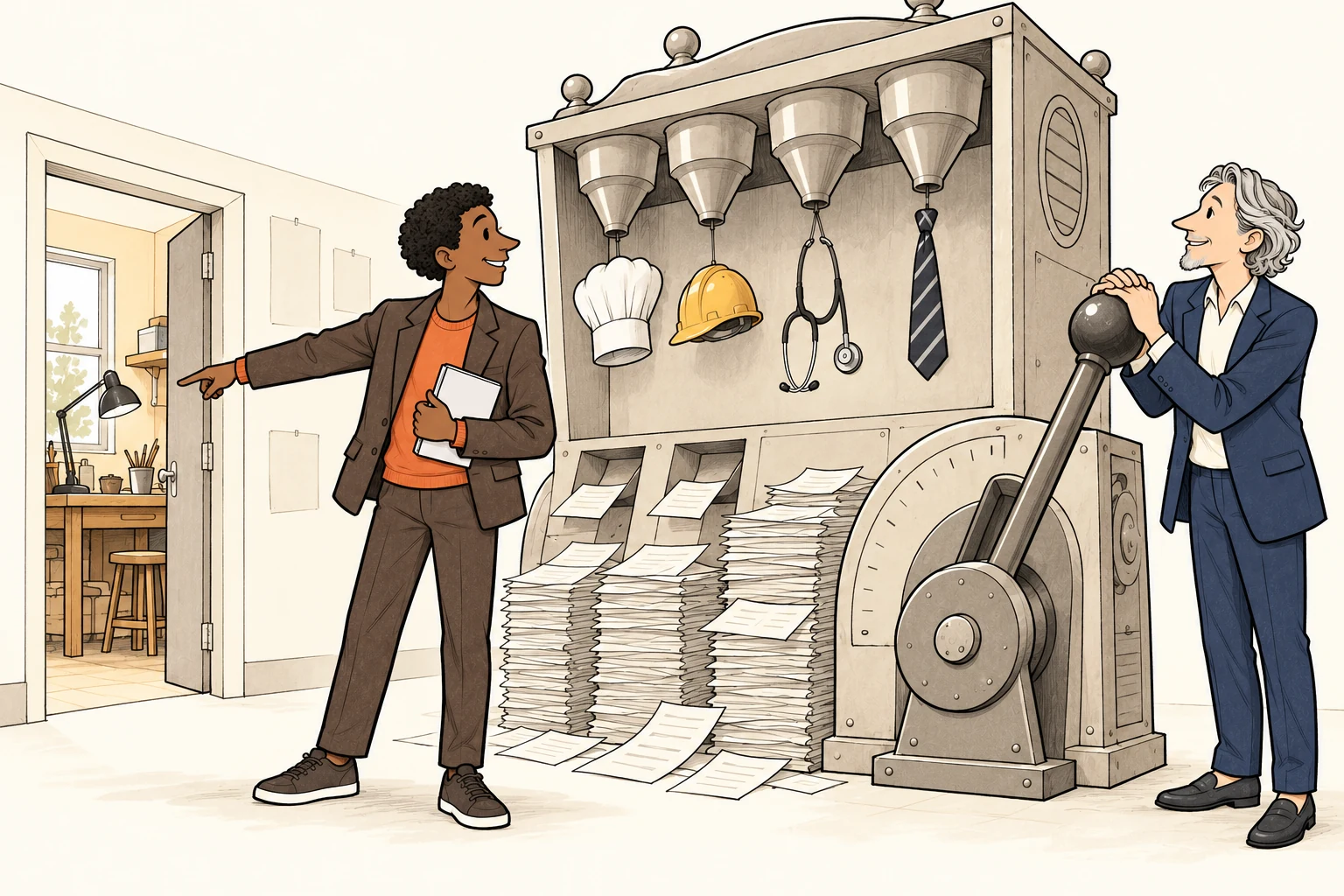
Jasmine, try it before you choose it
Your design placement helped you discover that an office job might not suit you. Then a conversation with your careers adviser helped you think about psychology. That is useful information. You learned it by trying something and talking to someone, without having your whole life planned first.
You can make smaller discoveries between placements, too.
Suppose you want to know whether you enjoy design. Invent a school film club and sketch a poster for its first screening. Ask AI for three different ways to arrange the information. Then choose, change or reject them. Can someone tell what the event is in five seconds? Is the date readable on a phone? Does it look like something you would want to attend?
Show it to a friend without explaining it. What they notice will tell you more than a chatbot announcing that your poster is excellent.
You have made something, tested it and learned a little about what you enjoy. You have not signed a contract to become a designer for the next forty years.
Start with the question you have now
Think about your phone. You probably did not learn every feature before you used it. You found something you wanted to do and worked out enough to do it. You can bring that willingness to try things to AI.
If a particular step has you stuck, a short tutorial can help. Watch that bit, then close the video and try it yourself. You do not have to become an expert in the whole tool first.
There is one difference worth remembering: AI can give you a confident explanation that is wrong. Getting comfortable with the controls is only the beginning. You need to get comfortable checking the answers, too.
McKenzie, you mentioned chemistry. Here is a useful way to bring AI into GCSE revision.
Pick one topic from the specification for your exam board and course. Your teacher can help you find the right one. Start with a question from your textbook or an official past paper, and have a go before asking for help. If you get stuck, try this:
I’m revising balancing chemical equations. Here is my attempt. Ask me one question that helps me find the mistake. Don’t give me the finished answer yet.
Now do something small but important: answer that question yourself. If the explanation is confusing, ask for a simpler one or a different example. You can ask again without a classroom watching.
Here is a deliberately wrong equation:
2H₂ + O₂ → H₂O
Count the atoms. There are four hydrogen atoms on the left and two on the right. Two oxygen atoms on the left, one on the right. Changing the right-hand side to 2H₂O balances it. A confident voice does not get to overrule your counting.
Then close the chat and try another question. Check it against the textbook or official mark scheme. A chatbot’s praise is pleasant; getting the next question right and being able to explain it tells you more. Exam boards publish specifications, past papers and mark schemes for exactly this kind of checking. [2]
The same idea works at A-level: use the material for your actual course, attempt the problem, and use help to understand where your thinking went wrong. You do not have to turn every difficult evening into a test of willpower. Ask for help, including from your teacher.
For homework and assessed work, follow the rules your school gives you. Submitting AI-written work as your own can be malpractice. You can use this revision method without pretending someone else’s answer is yours. [2]
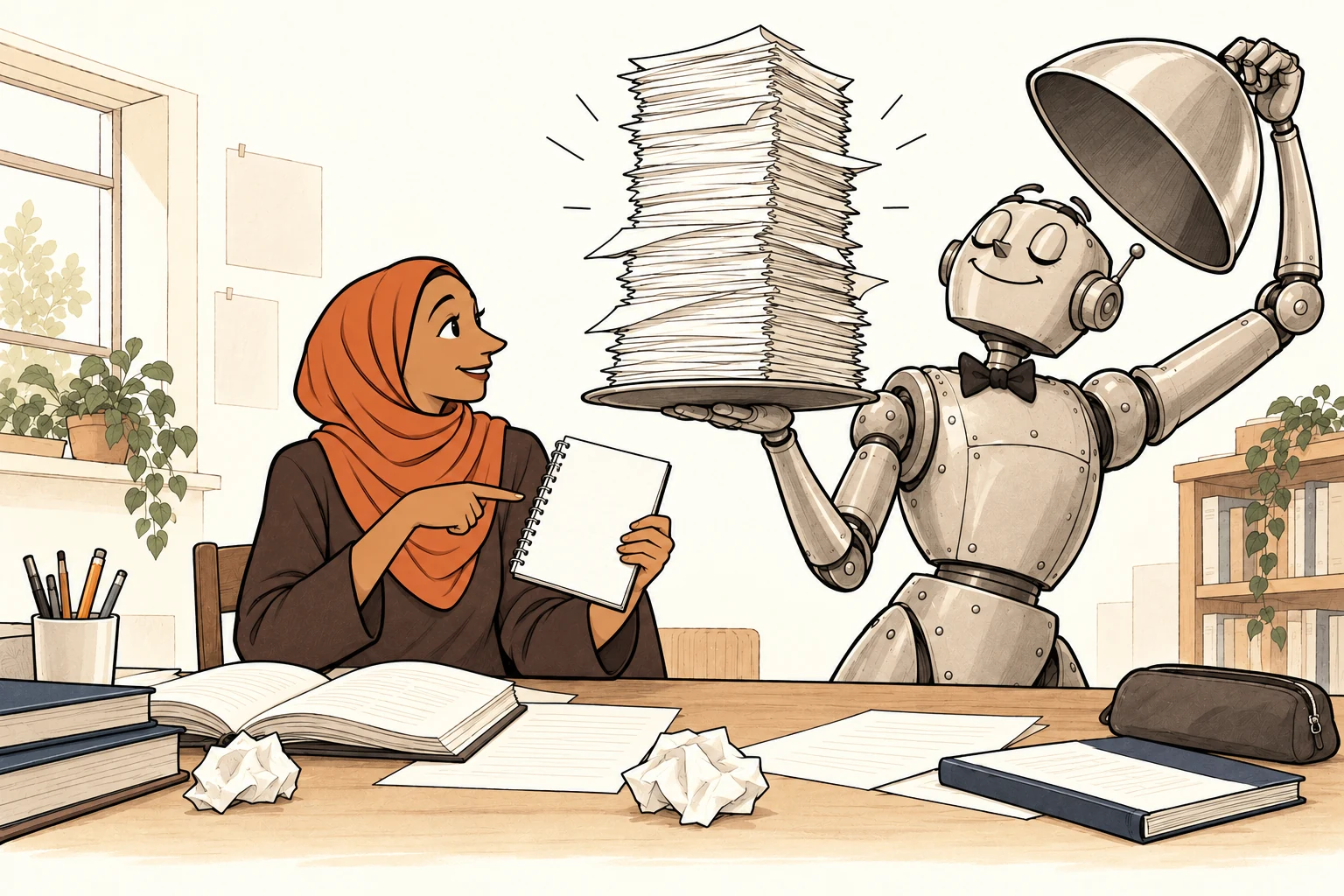
Laaibah, your objection matters
You were worried that handing every problem to AI could mean doing less thinking. I share that concern. An essay appearing on a screen is not proof that its owner has worked out what they believe.
Try using AI after you have written a rough view of your own. For a private practice essay, put down your main point and two reasons. They do not have to sound clever. Then ask:
Which of my reasons is weakest? What would someone who disagrees ask me? Don’t rewrite it yet.
Answer the objection, then revise your paragraph. You might change your mind or find a better reason to keep it. Either way, you have something of your own to say.
If you are researching a topic, ask where a claim comes from, then open the source. Does it actually say what the answer claims? Who produced it? When? If the link does not exist or the source says something different, you have found a problem. A convincing paragraph is not a substitute for that check.
At StepUp.One, I’ve spent seven years helping people learn complex subjects. One exercise we use now begins with a post and several possible comments, including deliberately weak ones. A beginner chooses the strongest response before they understand every part of the subject. The expectation grows as they learn: deeper understanding, then the ability to form and defend their own response.
That experience is why I care about your ability to judge an answer. But judgement needs something to work with. Learning chemistry helps you spot bad chemistry. Reading carefully helps you notice when a comment misunderstands a post. You can start before you know everything and keep building the knowledge that makes your choices better.
Param and Javaris, rehearse — then meet the person
You both noticed how much work involves talking to people you do not already know. No amount of tidy text on a screen can give you the whole experience of that first day.
It can give you somewhere to rehearse.
Before a placement, you could ask AI to play someone welcoming you to the team. Practise introducing yourself and asking about their work. For an interview, ask it to pose one question at a time, answer with something you have actually done, and ask which part was unclear. Then put the phone away and try the conversation with a real person.
Param, your interest in becoming a pilot gives you a starting question for someone who does the job: what is an ordinary day actually like? Javaris, you can ask the same of a doctor. AI can help you prepare questions, but the person may tell you something you would never have thought to ask.
That is one reason your request for more work experience matters. A rehearsal should help you enter the room. You still deserve the chance to go into it.
Isla, I cannot give you a guaranteed job title
You asked how you are supposed to choose a career if AI might change it before you get there. I cannot honestly promise which jobs will look the same in a few years. Neither can a chatbot.
You can still learn useful things without making that prediction.
Make a one-minute video explaining something you have just understood. AI could help you cut a rambling script, suggest an order, or point out a missing explanation. Use your own words and material you are allowed to use. Check the facts. Play it to someone: can they explain the idea back to you?
Or ask AI to help build a private, one-page website for that imaginary film club. Give it a simple job: explain the club, show a sample programme and make the next meeting easy to find. Then try it on a phone. Do the links work? Can someone read it? Have you accidentally put private details in it?
Those checks are part of making the thing. A page of code is not much use if the button does nothing.
You do not have to sell the video, find a client or become a “personal brand”. A small project that teaches you something is a good enough reason to begin. If you enjoy it, make another. If you do not, you have discovered something at a manageable cost.
Ella and Haider, a good prompt cannot pay the bill
You talked about expensive driving, education costs and opportunities that depend on where you live. Those are real barriers.
You can use AI to practise understanding a budget with invented figures. Give it a weekly bus fare and a monthly phone bill, and ask for a monthly total. Check that it has not simply added the two numbers. That is a useful mistake to be able to spot.
But the exercise cannot make an unaffordable opportunity affordable. Nor can a well-written work-experience enquiry make an employer offer a placement or cover your travel. Schools, employers and government still have work to do.
You should not have to buy a subscription to prove that you are serious. Start with what your school makes available, if anything. Check which tools are allowed for your age, and keep personal or confidential information out of them. Ask a teacher or trusted adult if you are unsure. [3]
If you do not have access, you can still make the first attempt, compare examples, ask someone to challenge your reasoning and revise what you made. These habits matter with or without AI.

I would like each of you to have more choices than you have now. That includes better support from adults, and the confidence to try something before you feel completely ready.
This week, choose one small thing: a question you want to understand, a conversation to rehearse, or a project you can finish. Use the help available to you. Keep enough of the work for yourself that you can say what you learned.
Jasmine, you said you now know that a happy working life does not depend on getting all grade nines. Hold on to that. You can take the next step without deciding every step after it.
— Anis