



Enterprise growth, built on relationships.

Your deal is decided in rooms you never enter.

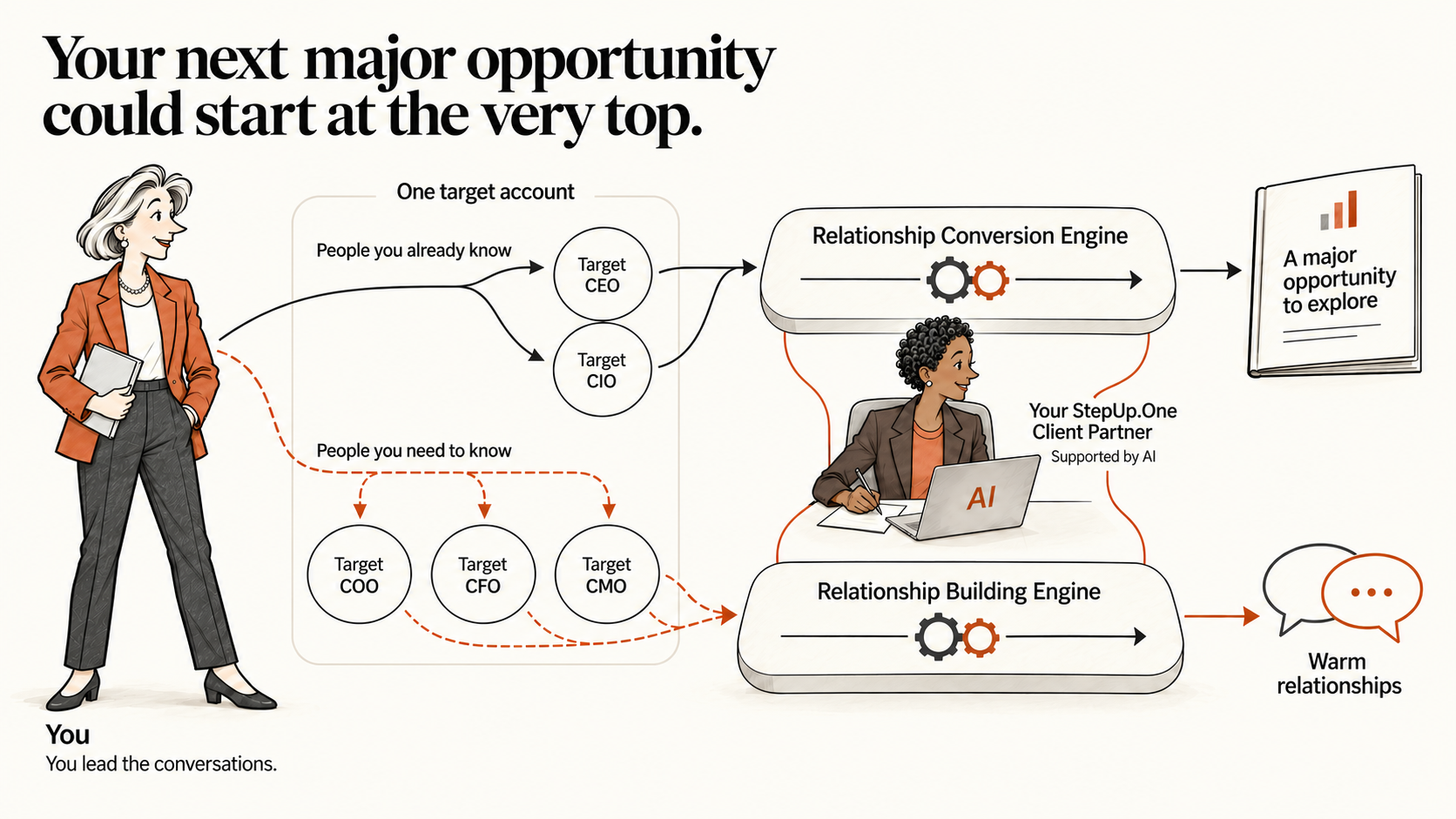
StepUp.One helps you build and nurture relationships with the people shaping buying decisions, before the commercial conversation begins.

An executive in a terracotta jacket stands outside a glass boardroom. A terracotta ribbon links his speech bubble to the conversation and speech bubbles of the people meeting inside.
Be the name they bring into the room.

How we work

Your relationships.
Our daily work.

Our trained, AI-equipped professionals work on your behalf through your LinkedIn, X (Twitter) and email.

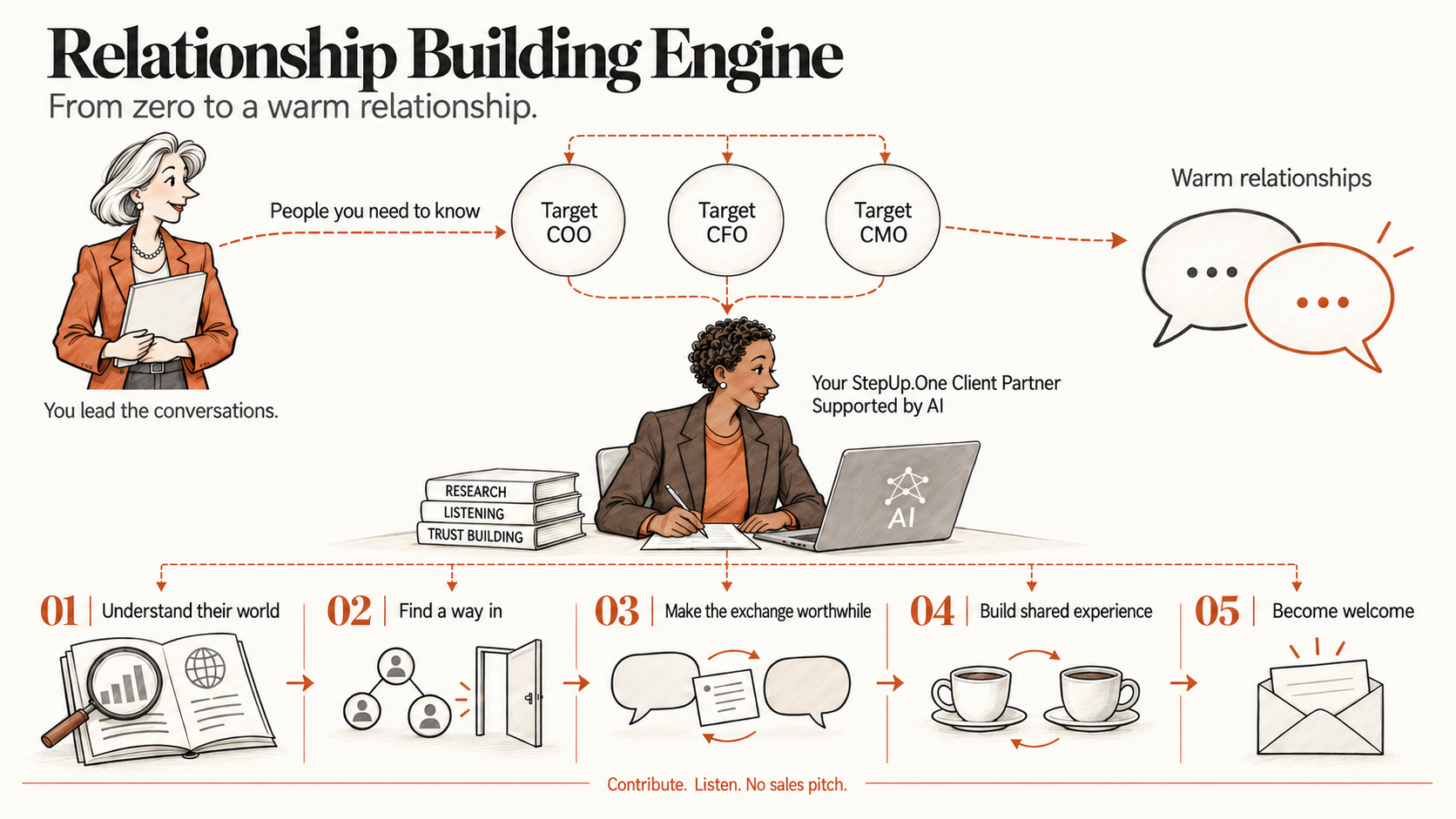
  1. Choose and map the account

    Agree priorities and where to begin.

  2. Understand the people

    Know who matters and what they need.

  3. Build familiarity

    Earn trust through useful engagement.

  4. Arrange meetings

    Prepare a worthwhile conversation.

  5. Sustain relationships

    Follow through and stay relevant.

See the 20 shared workflow steps
Choose and map the accountSteps 1–5
  1. Understand your offer

    Our role
    Research your strengths and the buyer problems you solve.
    Your team
    Set priorities. Explain delivery capabilities and constraints.
  2. Find potential accounts

    Our role
    Shortlist accounts with clear reasons to pursue them.
    Your team
    Share targets, customers and context beyond public research.
  3. Agree priorities

    Our role
    Recommend priority accounts and their Break In, Expand or Protect motion.
    Your team
    Approve priorities, effort and scope.
  4. Map buying centres

    Our role
    Map relevant divisions, functions, countries and buying groups.
    Your team
    Clarify budgets, decision authority and existing work.
  5. Choose where to begin

    Our role
    Recommend the first buying centres and sequence.
    Your team
    Approve the sequence. Flag sensitive or active conversations.
Understand the peopleSteps 6–10
  1. Identify stakeholders

    Our role
    Find decision-makers, evaluators, influencers, sponsors and implementation owners.
    Your team
    Add known contacts, introductions and informal influence.
  2. Understand priorities

    Our role
    Research each person’s role, priorities and challenges. Separate evidence from assumptions.
    Your team
    Add specialist insight and correct assumptions.
  3. Assess relationships

    Our role
    Record existing connections, familiarity and relationship gaps.
    Your team
    Explain who knows whom and the history.
  4. Assign ownership

    Our role
    Propose named professionals and coordinated relationship coverage.
    Your team
    Confirm the account owner, specialists and escalation contacts.
  5. Plan the approach

    Our role
    Prepare personal reasons to engage, useful contributions and suitable channels.
    Your team
    Agree tone, permissions and review. Supply approved expertise and proof.
Build familiaritySteps 11–14
  1. Engage with their work

    Our role
    Follow their work. Add thoughtful comments where useful.
    Your team
    Share relevant perspectives and context.
  2. Make a connection

    Our role
    Make contextual connection requests through agreed channels.
    Your team
    Enable introductions and resolve exceptions.
  3. Become useful

    Our role
    Sustain useful exchanges and follow-through before a commercial ask.
    Your team
    Supply specialist answers and relevant material.
  4. Assess readiness

    Our role
    Assess familiarity, interest, open questions and a reason to meet.
    Your team
    Confirm who can make the conversation useful.
Arrange meetingsSteps 15–17
  1. Arrange the meeting

    Our role
    Agree the purpose with the stakeholder; arrange and confirm the meeting.
    Your team
    Choose attendees and confirm availability.
  2. Prepare your team

    Our role
    Brief your team on the person’s priorities, relationship history, purpose and questions.
    Your team
    Review the briefing. Prepare relevant expertise.
  3. Hold the conversation

    Our role
    Coordinate the meeting and agreed note-taking.
    Your team
    Lead the conversation, answer questions and make commitments.
Sustain relationshipsSteps 18–20
  1. Capture what matters

    Our role
    Review authorised notes or transcripts; update priorities, concerns, commitments and next steps.
    Your team
    Provide the record and confirm what we learned.
  2. Follow through

    Our role
    Coordinate follow-up and track actions, or support your team’s follow-up.
    Your team
    Confirm commitments, supply answers and deliver agreed actions.
  3. Keep developing

    Our role
    Maintain relationships, notice changes and identify the next gaps.
    Your team
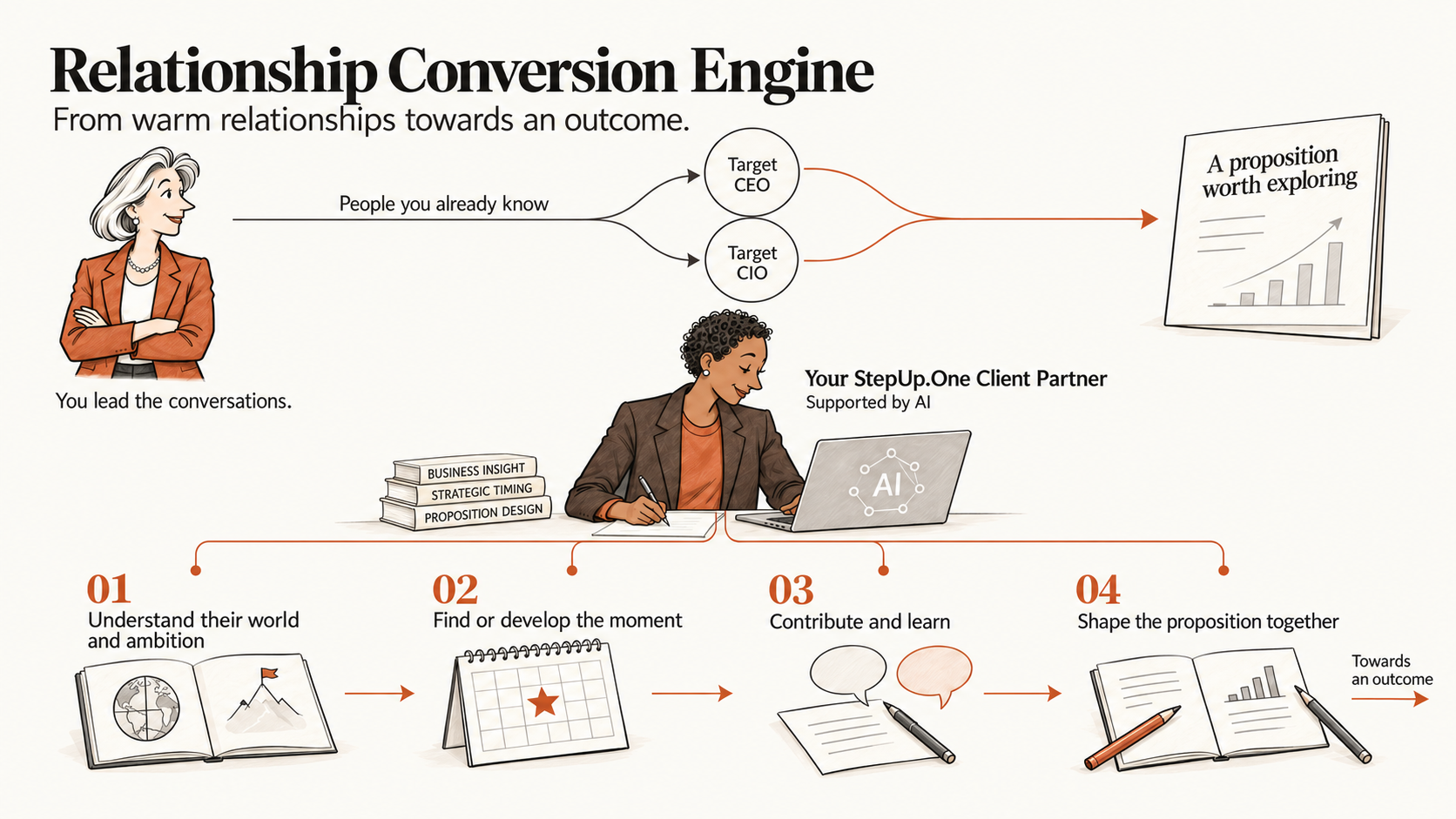
    Review progress, redirect priorities and lead commercial conversations.

StepUp.One builds and nurtures the relationships.

Your team brings the expertise and leads commercial conversations when the relationship is ready.

Explore the full methodology

IT closed the door. Finance opened it.

An enterprise data company.

An enterprise data company began with the usual data and technology audience. Research into other buying centres revealed an opening through Finance.

A Finance-led first meeting led to its first contract within six months of that meeting.

Illustration of a closed route through Data and technology, and a new route through Finance. A Finance-led first meeting led to the first contract within six months.
The first routeData and technology

The room stayed closed.

Another buying centreFinance opened the door

CFOs, finance directors and finance VPs.

Finance-led
first meeting
First
contract

Within six months of the first meeting

Different businesses.
The same need for trusted relationships.

  • Fujitsu
  • Expleo Group
  • OpenText
  • Zones
  • Freyr Solutions
  • Landor
  • Denodo
  • PureVPN
  • BMAT
  • Introhive
  • bigspark
  • B EYE
  • Autimatic
  • BioBrain
  • IMA360
  • Human Talent
  • MYNUSCo
  • Pure Technology
  • Krowd
  • Unchain
  • Trendwolves
  • River Recycle
  • Pepler Lee Group
  • ReachOut IT
  • 2,000+ contracted clients
  • 40,000+ first meetings arranged
Explore client experience
What these figures mean

These are cumulative figures supplied by StepUp.One in September 2026 across seven years of go-to-market work. Meetings arranged are different from meetings held or business won. The totals do not establish a conversion rate.

What does your account need next?

  • Break In

    Earn a credible opening.

    Find where your offer is relevant, understand the people shaping the decision and build towards a worthwhile first conversation.

  • Expand

    Grow beyond the work you already hold.

    Connect proven delivery with unmet needs, other buying centres and new decision-makers across the account.

  • Protect

    Strengthen the business you already have.

    Build relationships beyond individual sponsors, keep your value understood and stay attentive to changing people, priorities and concerns.

One account can need all three at once. We agree where the work should begin.

The judgement behind the work

Every interaction
needs a reason.

A connection, a comment or a meeting should make sense to the person receiving it.

Our professionalsContext. Judgement. Engagement.

Before contributing, our professionals ask:

Is it relevant?

What matters to this person, and how would this help?

Choose a question to explore.
AIResearch. Preparation.

AI assists research and preparation. Professionals check context, refine the contribution and engage personally. Your team provides specialist knowledge and directs the work.

The people behind the work

People who know how to put AI to work.

Our professionals learn the work, practise with feedback and apply it to real client accounts.

  1. Understand

    Know the client and the task.

  2. Practise

    Use AI. Check the work. Improve it.

  3. Perform

    Apply the skill to real client work.

Explore reskilling

Founded by Mohamed Anis, following 20 years in leadership roles at Infosys.

Our story

Looking for a different kind of support?